The Bugatti Veyron EB 16.4 is a mid-engined grand touring car. The Super Sport version is the fastest road-legal production car in the world, with a top speed of 431 km/h (268 mph). The original version has a top speed of 408.00 km/h (253.52 mph). It was named Car of the Decade (2000–2009) by the BBC television programme Top Gear.
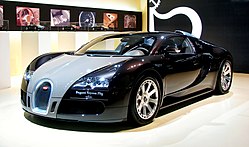
Designed and developed by Volkswagen Group (based on the Bentley Hunaudieres concept) and produced by Bugatti Automobiles SAS at their headquarters in Château Saint Jean in Molsheim (Alsace, France), the Veyron's chief designer was Hartmut Warkuss, and the exterior was designed by Jozef Kabaň of Volkswagen, with much of the engineering work being conducted under the guidance of former Peterbilt Trucks engineer and now Bugatti Engineering chief Wolfgang Schreiber. Though commissioned by Volkswagen, this car is only sold through the Bugatti manufacturers and cannot be found at any Volkswagen dealer.
A number of special variants have been produced, including two targa tops. In December 2010, Bugatti began offering prospective buyers the ability to customize exterior and interiors colours by using the Veyron 16.4 Configurator application on the marque's official website.

The transmission is a dual-clutch direct-shift gearbox computer-controlled
The car's wheelbase is 2,710 mm (106.7 in). Overall length is 4,462 mm (175.7 in), width 1,998 mm (78.7 in) and height 1,204 mm (47.4 in). The Bugatti Veyron has a total of ten RADIATORS
§ 3 heat exchangers for the air-to-liquid intercoolers.
§ 3 engine radiators.
§ 1 for the air conditioning system.
§ 1 transmission oil radiator.
§ 1 differential oil radiator.
§ 1 engine oil radiator.
The Veyron Super Sport features an engine power increase from the standard 1,001 metric horsepower (736 kW; 987 bhp) to 1,200 metric horsepower (883 kW; 1,184 bhp) and torque of 1,500 N·m (1,100 ft·lbf) and a revised aerodynamic package. It was shown publicly for the first time at the Pebble Beach Concours d'Elegance in August 2010.

Bugatti's official test driver Pierre Henri Raphanel drove the Super Sport version of the Veyron on Volkswagen's Ehra-Lessien high-speed test track to establish the car's top speed. With representatives of the Guinness Book of Records and German Technical Inspection Agency (TÜV) on hand, Raphanel made passes around the big oval in both directions achieving an average maximum speed of 431.072 km/h (267.856 mph). Once produced for sale, the first five Super Sports will sport the same black and orange finish as the first production car, which was used to set the speed record, and all production models will be electronically limited to 415 km/h (258 mph) to protect the tyres.
German inspection officials recorded an average top speed of the original version of 408.47 km/h (253.81 mph) during test sessions on the Ehra-Lessien test track on 19 April 2005.
This top speed was verified by James May on Top Gear in November 2006, again at Volkswagen Group's private Ehra-Lessien test track. May noted that at top speed the engine consumes 45,000 litres (9,900 imp gal) of air per minute (as much as a human breathes in four days). The Veyron has the highest top speed of any street legal production car. Once back in the Top Gear studio, James was asked by co-presenter Jeremy Clarkson what the Veyron felt like to drive at 407 km/h (253 mph), May replied that it was "totally undramatic", and very stable at speed. It only wobbled slightly as the air brake moved in the vertical position to slow the car down at lower speeds.
On 4 July 2010, Bugatti's official test driver Pierre Henri Raphanel piloted the Super Sport edition and was clocked at an average of 431.072 km/h (267.856 mph) on the same track, taking back the title from the SSC Ultimate Aero TT as the fastest production vehicle of all time. The 431.072 km/h mark was reached by averaging the Super Sport's two test runs, the first reaching 427.93 km/h (265.90 mph) and the second 434.20 km/h (269.80 mph). The record run was certified by the German government and the Guinness Book of World Records.
The car's everyday top speed is listed at 350 km/h (220 mph). When the car reaches 220 km/h (140 mph), hydraulics lower the car until it has a ground clearance of about 9 cm (3.5 in). At the same time, the wing and spoiler deploy. In this handling mode the wing provides 3,425 newtons (770 lbf) of downforce, holding the car to the road.

For top speed mode the driver must, while at rest, toggle a special top speed key to the left of the driver's seat. A checklist then establishes whether the car and its driver are ready to attempt to reach 407 km/h (253 mph). If so, the rear spoiler retracts, the front air diffusers shut, and normal 12.5 cm (4.9 in) ground clearance drops to 6.5 cm (2.6 in).
